
In the Realm of Mountain Kings.
Русский

Let me remind you first that Ragnarok awaits us all.
First will come the winter. It will be an unnaturally cold and dark winter, with no end in sight. Fimbulwinter. Then the wars will begin. The days will be dark, and cities will burn in the fires of war. In the third year of this dreadful winter, earthquakes will come. Those who did not perish in the wars or from the cold will succumb to the earthquakes. From the earthquakes, tsunamis will arise, and the ocean will overflow its shores. And then the gods will awaken and begin the great battle.
The seas will freeze to the bottom, and Loki will traverse them on his enormous ship Naglfar as if on a sled. Naglfar is made of the nails of the dead, and although the Vikings trimmed the nails of their dead to prevent the construction of this dreadful ship, it will still be the largest and heaviest ship ever to exist.
All gods and giants, dead and alive, will gather for the final battle on the plain of Vigrid. And in this battle, the wise Odin, the tempestuous Thor, and the fearsome Loki will perish (and Loki, I suspect, will indeed be fearsome, for only now will he be freed from his long captivity and will finally tear apart the sons of Kishi with whom he was bound). It will be a bloody battle, one that no one can prevent. Thus will end all nine worlds.
Will this happen soon, or will we live a little longer, who knows? Although I've been waiting for Ragnarok for a long time (I'm not sure what exactly broke my psyche, the choices are wide these days), but it's still interesting to see the places guarded by the Norse gods.
And so we set off to Norway. The boys were choosing the destination for our summer vacation. Since I have a great love for both Norse mythology and the Viking era, I was thrilled with the boys' choice.
We flew with Irish airlines, with a layover in Dublin. You couldn't find a greater contrast between the airports. Oslo, in contrast to Dublin, was empty, sterile, and gleaming. We immediately began to admire it, of course. And it must be said that we had plenty of reasons to admire Norway throughout our journey.
Here, at the airport, we rented a car and, already quite exhausted from two flights, set off to our first hotel.

In Norway, it was already evening at this time, or rather the white night was approaching, and according to our biological clocks, it was morning after a sleepless night. Well, it was the usual jet lag when crossing the ocean. We checked in and crashed. The road day ended, which doesn't really count.
The first day
began with a fantastic breakfast. The day before, we had read an article about the white nights in Norway, which mentioned the long winter polar nights that provoke depression among Norwegians due to the lack of sunlight."I think in a country where people have breakfast like THIS, no one can possibly have depression," remarked Arseniy, looking at all the abundance before him.
After breakfast, we went for a walk around Oslo. Of course, now it's a modern and stylish city, but it was founded about a thousand years ago by the last true Viking, Harald Hardrada, one of the many powerful heroes who fought everywhere from Norway to Africa, traded and plundered endlessly, wrote complex and refined poetry, and were extremely romantic (especially in the sagas where heroes split their enemies' ribs, extract lungs, and always recite poetry).
I mentioned Harald in my story about England and Emma of Normandy. This is the same Harald who, after receiving a refusal from Elizabeth Yaroslavna, traveled the world and wrote numerous verses in the Viking tradition, each of which ended the same way:
"However, the girl in Gardar doesn't want to show affection towards me."
Eventually, Elizabeth did become his wife, and by "Gardar" or "Gardariki," the Vikings referred to Rus. Sailing on their ships along the Volga, they saw numerous fortresses, so all of Rus seemed to them like a chain of cities, which sounded like "Gardariki" to the Scandinavian peoples.
Harald Hardrada perished trying to conquer England, marking the end of the three-hundred-year Viking era. But thanks to him, we can now stroll through the beautiful city of Oslo.
We parked in the city center. Even the tram tracks set a certain mood.

Here we're walking on the roof of the opera house.


From above, we gaze at the woman-troll and decide to head towards the Royal Palace.


We got a little lost, but we weren't bothered at all. Walking around Oslo is very pleasant - it's just drowning in flowers and greenery, and the weather was perfect.

Finally, we reached the palace, which turned out to be rather modest.

After walking around the city, we decided to visit some museums.
The main museum we wanted to visit, the Viking Ship Museum, turned out to be closed for renovation until 2026. So we continued on to the Fram Museum.
The Fram is a large sailing ship built at the end of the 19th century, which was first used by Nansen and then by Amundsen, both in the Arctic and the Antarctic. It circled the globe 2.5 times in total.


In such Arctic expeditions, there was always a very real chance for the ship to become trapped in ice. After that, the ship was at risk of being crushed, or it could withstand it, but such entrapment could last for several years in case of a cold spring and summer. Indeed, these misfortunes befell the "Erebus" and the "Terror," and not only them. Nansen, of course, was aware of this and therefore decided to improve the design of his ship. He made it round so that the squeezing ice floes wouldn't crush it but rather push it to the surface like an egg. And his calculations proved correct - the "Fram" was perfect for navigating through ice. However, the rolling on such a ship was much stronger, so even experienced sailors could hardly bear such a tossing, and dogs had to be constantly tethered to the ship's walls to prevent them from falling overboard.
Now you can walk around the ship, exploring everything from the cabins to the hold. Videos of the Arctic Ocean are constantly projected onto the museum's inner walls, rain lashes down, masts sway, sails flap, and you can even enter the pantry and the dead room, where the temperature is set to what it was on the ship during the voyage to immerse visitors in the atmosphere. So, there's darkness, a chilling cold, and frozen corpses. Pretty spooky. Overall, it's a fantastic ship and a great museum experience.
Next to the Fram, literally opposite, is another museum dedicated to maritime voyages - the Kon-Tiki Museum. The Kon-Tiki was Thor Heyerdahl's raft, on which he made his voyages across the Pacific Ocean. (Funny enough, despite knowing about Thor Heyerdahl from an early age, I never realized that his actual name was Thor, like the god of Thunder. In Russian it sounds like Thur)
Here in the museum, you can see both the Kon-Tiki raft, on which Thor and his team crossed the Pacific Ocean, and the Ra II papyrus boat, which became famous in the Soviet Union thanks to Yuri Senkevich, and on which they crossed the Atlantic Ocean, albeit on their second attempt.

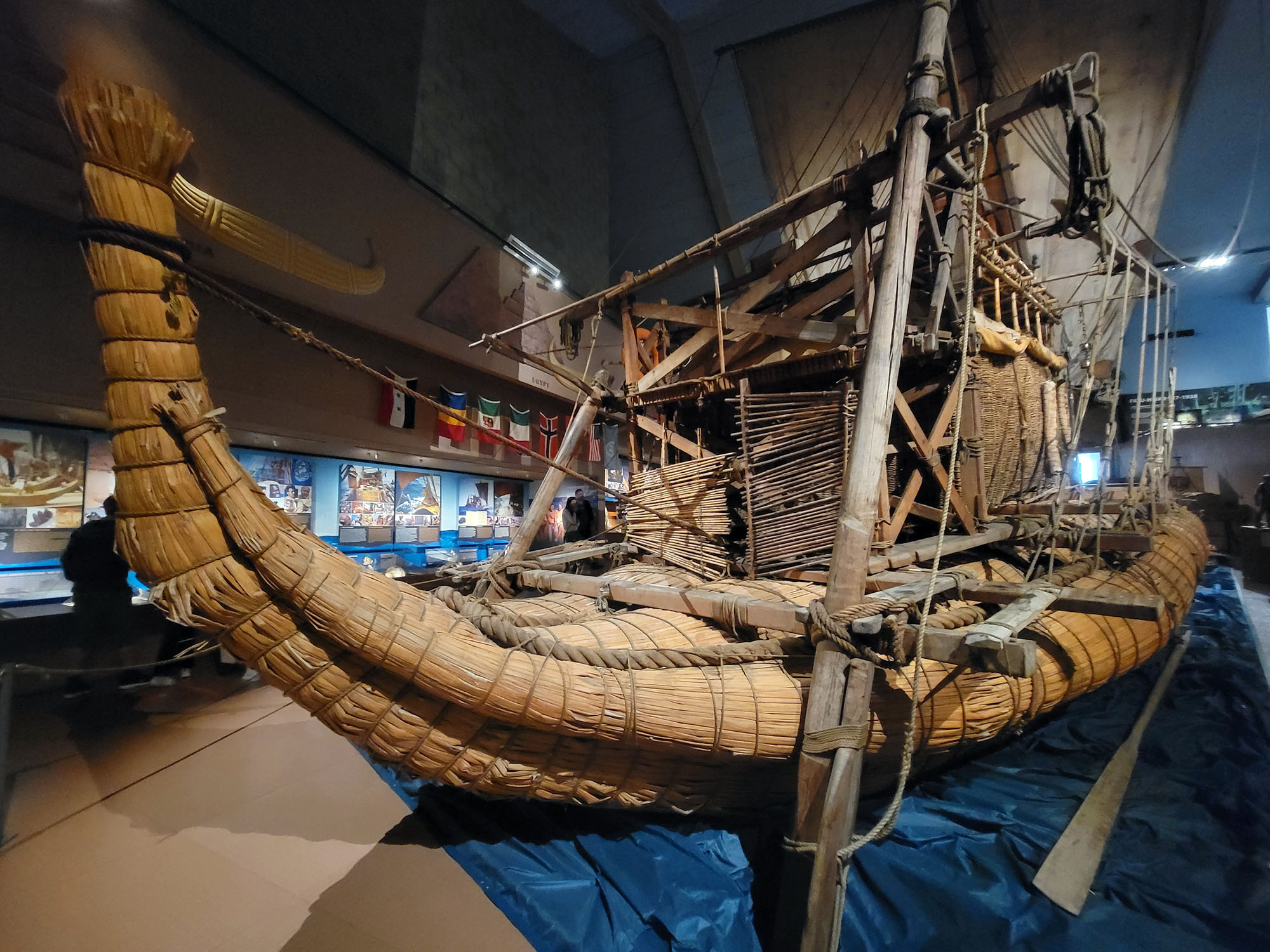
Indeed, sailors like the Norwegians are hard to find. (Not to mention the Vikings, who sailed to America half a millennium before Columbus.)
Right here, on the Bygdøy Peninsula, not far from the maritime museums, is the vast Norsk Folkemuseum - an open-air museum.


The houses here are also extraordinary - for example, this one dates back to the 1300s.


In the hotel, we were greeted by a beautiful pool and spa. Arseniy didn't like the saunas at all, but he and Ilya had plenty of fun with their game of "dip into the icy water, then run to the hot tub." Unfortunately, taking photos there was prohibited.
Second day
In the morning, we headed to the famous Vigeland Park to see Gustav Vigeland's sculptures.

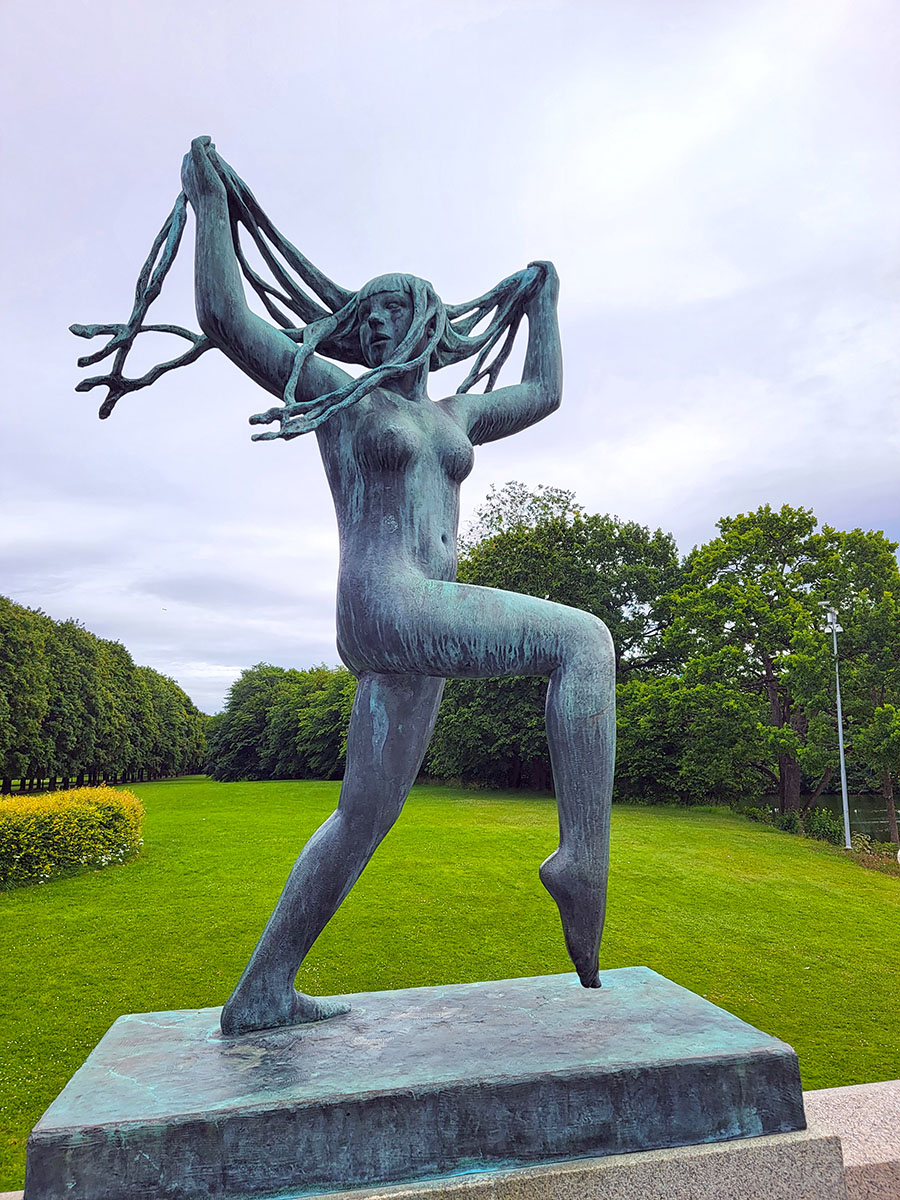


After a satisfying stroll, we headed to the city market. We needed to buy some groceries, and we were curious to see what Norwegians eat. Judging by the Mathallen market, Norwegians love fish and a variety of pastries. Which, frankly, was to be expected.

It was time to leave Oslo and head west.

We stopped for the night in the town of Geilo, which in winter is a ski resort, and in summer attracts tourists like us traveling from Oslo to Bergen. In the evening, we only had time to stroll around the charming town, admire the postcard-perfect landscapes, and discover that our drone was broken, which meant we wouldn't be able to see beautiful panoramas from above.

Third day
What's great about Norway is that you don't need to wait to arrive from point A to point B to enjoy the incredible beauty of nature. You just need to get in the car and simply stop at ANY place.

On this day, we continued to leisurely make our way towards Bergen, stopping and strolling in pleasant places along the route.


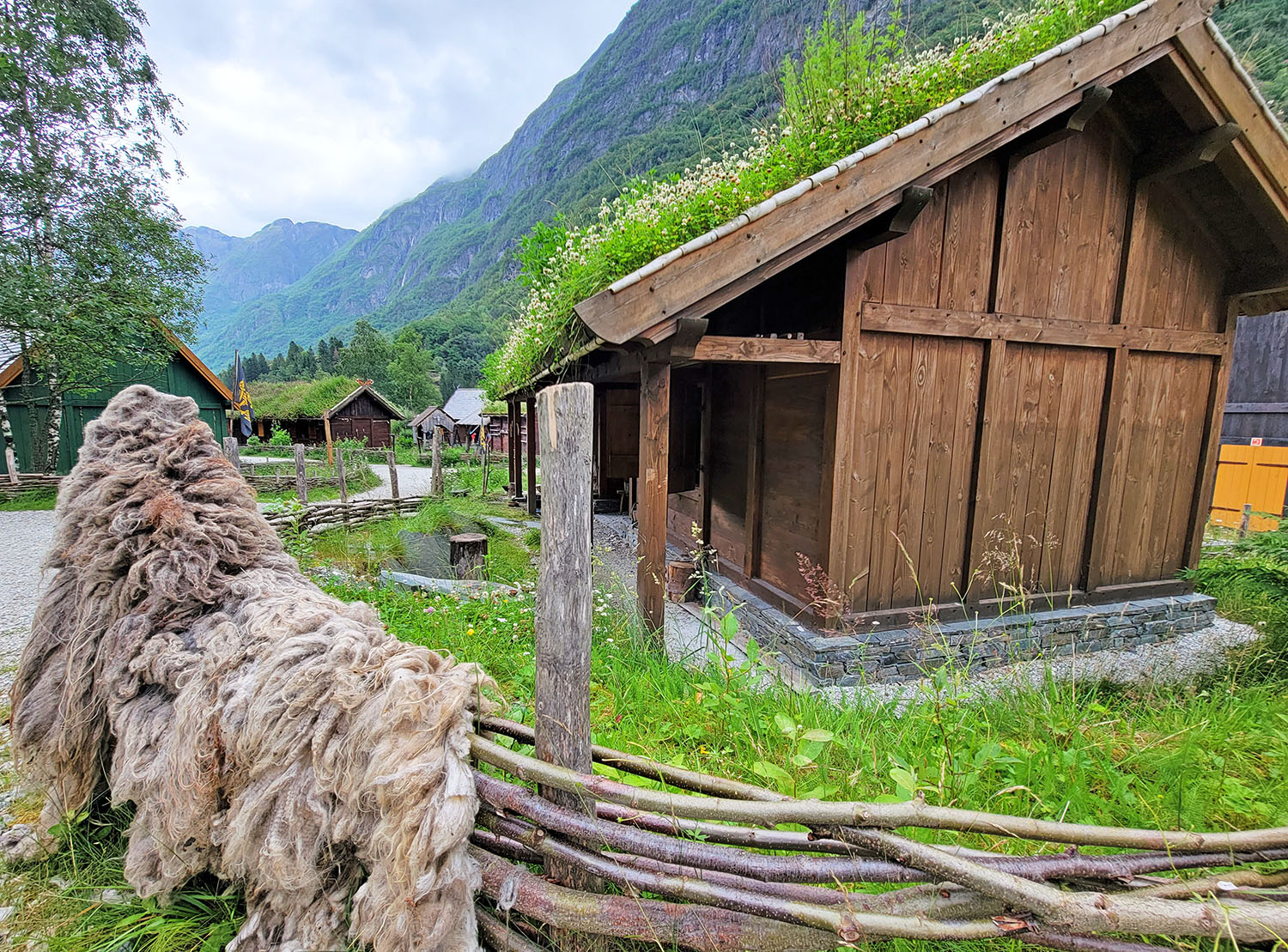
And just as the thought crossed our minds, a real Viking village appeared in the valley between the mountains.

Here, indeed, we felt as though we had been transported back a thousand years.


And while trying not to get in their way, we watched the Viking boats, observed how their houses were arranged, witnessed the forging of their swords in the smithy, observed the spinning and dyeing of wool yarn, watched them cook in the outdoor oven, and consulted the runes. We even tried on helmets and engaged in mock battles with wooden swords.


It's not surprising that Arseniy preferred a book about runes over all possible souvenirs, immersing himself in it right away. And I immediately recalled another saga. In the saga of Egil, there was such an episode – the Viking Egil stopped for the night in a house and noticed a sick woman lying on a bench. No one knew what illness had struck her, but the local healers had already carved runes to heal her, only after which she became even worse.
Egil looked at the other runes and burned them. Then he carved his own, placed them under the girl's pillow, and said:
"Runes should not be carved
by those who do not understand them.
In unfamiliar signs,
anyone can go astray."
"The next morning, the girl woke up healthy."
When Egil was in conflict with Eric Bloodaxe, he cursed him using runes and a horse skull. The stakes with curses carved on them and the horse's head were called 'nid' and possessed terrible power. There is a story where, upon reading such a nid in the chieftain's hall, the weapons hanging on the walls came to life and struck all the warriors present, including the chieftain himself, whose hair 'rotted' at the same time
In general, these runes are a serious matter
Well. Moving on.
For the night, we stopped at the famous Stalheim hotel. The hotel has a two-hundred-year-old, and to put it mildly, not a simple history, especially during the Second World War.
We got a wonderful two-bedroom corner room with a panoramic view from the window:


Forth day.
The further west we went, the more complicated the tunnels became, the more beautiful the landscapes, and the higher the waterfallsNorway is a true kingdom of mountain kings. What Norwegians accomplish within the mountains amazed us. They don't just build tunnels in the mountains; they create branching, multi-level, spiral tunnels that delve deep into the mountain, emerging on the surface only to bridge between mountains with a bridge and then dive right into the next one. They even lay tunnels along the seabed between islands instead of bridges, and so on. Add to this the colorful lighting for visual relaxation and psychological peace - in general, Norwegians are in harmony with the mountains, and the mountains submit to them

We took a stroll to one of the waterfalls.


Took a walk along the fjords.

We finally reached Bergen. However, the weather let us down. It was quite warm, but there was such heavy rain and poor visibility that we had to cancel our planned ascent on the funicular. Our walk around the city center turned out to be quite short and rushed

Most people probably know that Bergen is the second-largest city in Norway after Oslo. It used to be the capital before Oslo took over, and now it remains the country's largest trading port
Despite the downpour, Bergen seemed like a very charming city to us. Unfortunately, I didn't take any photos – I didn't want to risk my phone getting wet.
For the night, we stayed at the "Edvard Grieg" hotel. It's worth mentioning that Grieg is practically a national hero here. And, in my opinion, the great love of the people is more than deserved.

Fifth day.
Started with the maritime museum in Bergen. The museum covers over two thousand years of Norwegian shipbuilding history. From the first dugouts to modern cruise ships.


You can watch a good movie about Viking ships. Well, and admire all kinds of boats and ships from all times. A very decent exhibition.
We drove around Bergen. And now we're heading south and a bit east, to the town of Eidfjord.
On the way, we're walking to the waterfall.


By the way, one of the charming features is that the toilets at the beginning of the trails often delight with transparent floors, through which you can observe the flowing river or stream.
Walking more- I don't even know if these are fjords or just lakes.

We're approaching our next hotel - Fossli.
I'm taking the official picture of the hotel again to better convey the beauty of the location.

The views from our room window look like this:

But as soon as we were ready for a walk, it started to rain, and a cloud settled right over the hotel, and the places that promised us wonderful waterfalls opened up to us in about this light:

We did walk around, of course, but we saw only slightly more than what is shown in the photo. sad
Sixth day
On this day, we had to reach the most beautiful city in our trip - Stavanger. Well, what can I say, it's no wonder the author of the Norwegian coastal lines Slartibartfast was awarded somewhere deep in our beautiful galaxy, not for nothing.

Waterfalls – big, small, right by the road or a little further away – they appeared in such abundance that we lost count.


The road to Stavanger from the north passes through the fjords, so part of the journey requires taking a ferry. The ferry service is organized so well that it doesn't cause any delays for motorists.

We simply drove up to the ferry crossing, loaded onto the ferry within minutes, and set sail. The ferries run one after another seamlessly.
And after the ferry, the landscapes suddenly changed to exactly match the image that always came to mind when I heard the word "Norway": Northern landscapes.

In Stavanger, the weather didn't disappoint us, and the city revealed itself in all its splendor. Hooray! We quickly checked into the most beautiful hotel on earth and rushed out to explore the city. And what a beautiful city it is! Endless descents and ascents. And beauty everywhere. No words can describe it!


At the end of our wonderful walk, we found ourselves in a little restaurant where we were served a magical parsley soup. Essentially, it was a fish soup , but instead of broth, it had a thick creamy parsley-lemon puree. Amazing flavor!
The dessert didn't disappoint either.
Seventh day.
After the breathtaking breakfast at the Hotel Victoria (and I'm not exaggerating about their breathtaking quality, because these breakfasts can't be compared to cruise or all-inclusive hotel buffets. I'm not adept at photographing food in the presence of people, but just to give you an idea: there's a separate table for yogurts dedicated to what you can add to these yogurts. I won't even start on the variety of fish, cheese, meat, fruits, and hot dishes.)

The white streets, houses adorned with flowers of all kinds, green picket fences, and neat low fences—everything in Stavanger feels like a fairy-tale setting.


In every window, there are charming accessories, lace, toys. It's hard to believe that these are residential areas. In such places in Europe, I usually feel delighted—I adore such streets and houses, but only as a sightseeing experience. Stavanger is one of the wealthiest cities in Norway and its oil capital. Since our hotel was right on the waterfront, we could see huge cruise ships docking one after another in the center, unloading and loading hundreds of tourists non-stop.

And we, in turn, boarded a small but equally remarkable boat to see one of Norway's most beautiful fjords – Lysefjord. How wonderful it is that Norwegians love and appreciate Edvard Grieg because sailing with musical accompaniment is a special pleasure. Such a healing atmosphere, such a recharge – just what the doctor ordered.


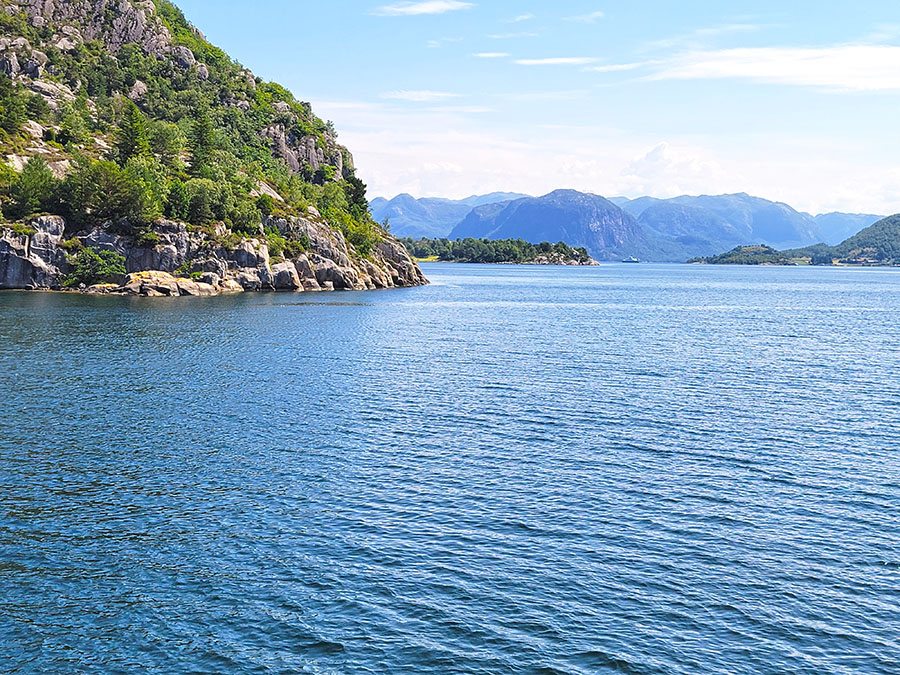

We admired from the water the famous Preikestolen. It was breathtakingly beautiful. Needless to say, no photograph could ever capture the scale. The cliff stands at a height of 604 meters, just to put it in perspective.


Three hours flew by in the blink of an eye.
We returned to the port and went for another stroll through the city. It was impossible to bid farewell to it.


We stumbled upon a tiny Italian restaurant with just four tables. We had dinner there.
We spent the night in the same hotel.

Eighth day
It's time to head east towards Oslo. But before that, we need to visit one iconic place in Stavanger: the Three Swords.

This Harald became a king after his father's death when he was only 10 years old. After many years of fighting for his rightful lands and conquering neighboring territories, he sent messengers to the daughter of one of the kings. Contrary to expectations, Gyda refused him, instructing him to return only when he became the king of all Norwegian lands. Upon hearing this response, Harald was surprised only that such a thought had not occurred to him before.
And immediately he made a vow not to cut or comb his hair until he conquered all of Norway.
So King Harald became Harald Hairy and the gatherer of Norwegian lands, using methods that weren't limited to fair battles; he could easily set fire to an enemy king at a feast along with a hundred guests. (Unfortunately, it requires a separate reminder to present-day Land Gatherers that it's not the ninth century anymore).
His vow solely concerned his hair, as his pursuit of land at his fiancée's request did not prevent him from simultaneously marrying another woman.
In short, the final battle against the united kings opposing him took place right here, in Hafrsfjord near Stavanger. The battle was long and brutal. And Harald Fairhair emerged victorious. Norway was united for the first time under the rule of one man.
Now he could finally go to the bathhouse, wash himself, get a haircut, and comb his hair. After all, 10 years had passed. And it seems that the result made such a strong impression on those around him that throughout the centuries, Harald remained Fairhair. So, looking like a charming prince, he went to his girlfriend Gyda. And soon he married her and many others. Then, however, he married Ragnhild the Mighty and drove away all nine wives.
By the way, I've always been greatly interested in the stories behind unconventional royal names. Sure, names like "The Fair-Haired" and "The Mighty" are pretty self-explanatory, and you find your share of "The Brave," "The Stern," and "The Beautiful" in every kingdom. But the Norwegians have some truly unique names you won't find anywhere else.
Take, for example, the sons of Ragnar Lothbrok - what a lineup! Sigurd Snake-in-the-Eye! When Ragnar decided to marry, his wife Aslaug wasn't too keen on the idea. She told him that if she gave birth to a child with a snake in their eye, he would have to forget about his plans. However, if the child was born without this trait, he could marry whomever he pleased. When Ragnar looked at the newborn, he realized that polygamy was off the table. Modern researchers suggest that it might have been due to a mutation in the Rah6 gene. Eyes with this mutation can indeed look like this:

Or their first son - Aslaug asked her husband not to sleep with her for three days, but Ragnar didn't listen, and as a result, their son was born boneless. Now it's considered quite likely that Ivar the Boneless had osteogenesis imperfecta, or brittle bone disease. However, it's not entirely clear how he survived being catapulted onto a sacred cow, but those are just details.
Well, I got distracted again. And the monument to the momentous event in the form of three swords was erected in the 20th century - the swords are "embedded" in the stone to remain there forever.
We continue our journey - making a stop in the town of Flekkefjord. Unlike Stavanger, the town is small and not at all touristy, yet it's just as white and blooming.

We had lunch and went for a walk around the town, away from the center and the waterfront, towards the residential areas - but even there, we observed the same doll-like decorative whiteness.


Nevertheless, the city center is still charming. We strolled around the whole evening and even stayed overnight here.


Ninth day.
On that day, we decided to hike two trails. The first one was right near the city – a simple and lovely forest trail through birch groves along quiet little lakes.


The second one was a bit further away but very unusual. It was a 4-kilometer (8 kilometers round trip) route along wooden canals that were used for log transportation for many years. Today, they have been repurposed into a pedestrian trail due to their disuse.


After the trail, we stopped by a tiny little town, had lunch, and then headed back to Oslo.
We completed the circle back at the same hotel where the journey began.
Tenth day.
In the morning, we flew out of Oslo on a tiny airplane the size of a bus and within two hours, we were already in Dublin. We exited the airport and took a regular shuttle bus to the city center.
"Should we wear masks?" some girl asked the driver.
"Well, if you need to conceal your face for some reason, then go ahead," he replied.
That settled it. By the way, Norway hasn't been playing these pseudo-medical games for a long time, so we didn't see a single person wearing a mask throughout our trip, let alone any other requirements. Touch wood.
We had very little time in Dublin – basically, the remainder of that day after arriving and checking into the hotel.
After the quiet, empty, and impeccably clean Norway, Dublin was definitely a bit of a shock to the system. Crowds everywhere, bustling streets in the center, slightly less cleanliness just off the center, noise, hustle, traffic, double-decker buses, crowded bus stops, smoking everywhere, chatter... We reached the hotel feeling somewhat bewildered. After dropping off our things, catching our breath, we headed towards the city center. As we walked and gradually got used to it, we realized that the scruffy crowds in ripped tights weren't junkies or troublemakers but just ordinary groups of students who, like me, happened to like the gothic architeture style. And the people shouting from buses weren't rowdy troublemakers but cheerful tourists with energetic guides. In short, everything turned out to be much nicer than it initially seemed.


We had a delicious lunch and then headed towards the most beautiful Gothic architecture, which is not common in Norway.
We arrived at St. Patrick's Cathedral. One could talk for hours about this cathedral, but I've already crossed all reasonable limits, so I'll limit myself to three details that impressed me the most.
The first and most awesome thing is the flags. If you look up from the altar, you can see dozens of flags of varying degrees of decay. They have been hung there for centuries in memory of the Irish warriors who fell under these banners. Some of the flags have deteriorated to such an extent that only small shreds of fabric remain, which will probably just fall off soon. There are debates within the cathedral about whether to remove the flags and place them in conditions suitable for preservation for centuries, or to leave them hanging for all to see, as originally intended. Well, for now, they remain hanging.


The second thing is the Door of Reconciliation. Right inside the cathedral stands a door. The story of the door goes like this:
Two households, both align in dignity
two Irish families had been feuding for years. By 1492, their feud had escalated to the point of a full-blown war with clashes in the city streets. In one
of these clashes between the Butlers and the FitzGeralds, a Butler had to flee. He hid within the grounds of St. Patrick's Cathedral.
The FitzGerald pursued him right up to the door behind which the Butler had hidden and shouted that the feud had gone on long enough and it was time to make peace. However, the Butler didn't trust the enemy's word. So, the FitzGerald ordered a hole to be cut in the door and reached his hand through it for a peaceful handshake. The Butler realized that the FitzGerald was willing to risk his hand, indicating a sincere desire for peace. Reconciliation was achieved. And so, the door was preserved in memory of this event.

And thirdly – here lies Jonathan Swift, who was once the dean of the cathedral.
By the way, he was a remarkable dean. He made every effort to help the poorest and sickest, maintaining a shelter and hospital of St. Patrick. The poor of Dublin held him in great affection. Spending all resources on the maintenance of the cathedral, he noticed the dilapidation and neglect of the graves and monuments around the cathedral. Swift sent letters to the relatives of the deceased asking for donations to restore the memorials. In case of refusal, the restoration was carried out at the expense of the cathedral funds, but a plaque stating the relatives' stinginess and ingratitude was placed on the gravestone. One such letter was sent to King George II of Great Britain and Ireland himself. The letter was ignored, so now the grave of his relative bears a plaque denoting the stinginess and ingratitude of the king.
The clinic for the mentally ill, opened with Swift's funds, still operates to this day (since 1757!).
In general, over the 800 years of the cathedral's history, so much interesting history has accumulated that one could indeed write a separate book about it, and there are probably such books out there.


This cathedral is even older. It was founded by a Viking who converted to Christianity almost a thousand years ago.

Here you can descend into the crypt and treasury.


In the 19th century, during the cleaning of the organ, mummified remains of a cat and a mouse were discovered, preserved for posterity.

And Henry II came here after the murder of Thomas Becket. But if I start telling the details now, I'll end up on another 10 pages. So I'll stop here.
No, just 5 seconds - this guy, for example, Richard de Clare (Strongbow) - he's the father-in-law of my favorite William Marshal, the father of Isabella de Clare, whose castle in England we visited. Fought alongside his King Henry II against his wife, my beloved Eleanor of Aquitaine. Then he returned to Dublin to maintain order. He got wounded in the leg and died. He's been lying in this church for 900 years already.


I really wanted to visit the library, but it turned out that entry there is by tickets, and there are no more tickets available for sale.
Well, that's fate.
We walked along the waterfront for a bit.

Dublin turned out to be a wonderful addition to the Norwegian journey.
Day eleven. Spent the entire day flying back home.
We thank beautiful and hospitable Norway for the opportunity to see its beauty. This is one of those cases where one visit to a country is simply not enough. Special thanks to wonderful Ireland for its divine cathedrals.
P.S. Rumors about the high cost of living in Norway are greatly exaggerated, especially compared to American prices in 2022. The biggest and most unexpected plus of Norway for us was the complete absence of crowds and traffic jams; the sparsely populated Norway is perfect for introverts.